FULL STORY: The Woman in the Back Seat Knew Where Every Dollar Went 029
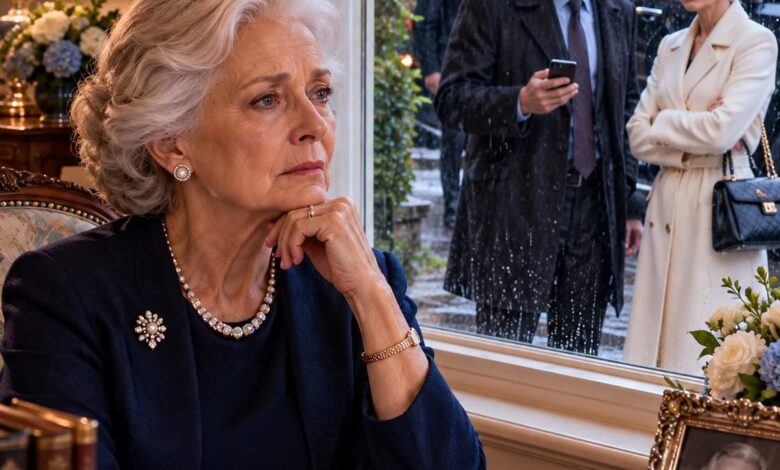
The third person stepped out slowly.
She was an older woman, perhaps a few years younger than me, wearing a dark green raincoat and carrying a flat leather folder against her chest.
For one confused moment, I thought I recognized her.
Then she lifted her face toward the house.
My breath caught.
I knew that expression.
Not the woman herself.
The look.
The careful uncertainty of someone who had arrived expecting to defend another person, only to discover she might have been defending the wrong one.
Benjamin stood beside the car, staring at my front door as if it had become the entrance to a courtroom.
Genevieve did not look at me.
She was watching the older woman.
That was when I understood the visitor had not come merely to support them.
She had come because something had changed.
I released the curtain and stepped away from the window.
The house seemed unusually quiet around me.
Thomas’s clock ticked from the mantel.
The kettle remained where I had left it, cold and empty.
I looked down at my hands. They were steady.
That surprised me.
For fifteen years, any hint of trouble involving Benjamin had sent me into motion. I had paid first and asked questions later. I had accepted explanations before they were finished. I had treated every emergency as if my love could prevent consequences from reaching him.
But that morning, with three people standing outside my home, I felt no urge to run toward the problem.
Only the desire to understand it.
The doorbell rang once.
Then again.
I did not hurry.
When I opened the door, damp air entered the hallway, carrying the scent of rain and wet cedar from the front steps.
Benjamin looked older than he had the night before.
Not physically.
Something in his posture had collapsed.
His hair was untidy, and the collar of his shirt was unbuttoned. He held his phone loosely in one hand, though the screen continued to flash with notifications.
Genevieve stood behind him, composed except for the faint tremor in her fingers.
The older woman remained near the car.
Benjamin swallowed.
“Mom.”
I waited.
His eyes moved over my shoulder, past me and into the house.
Perhaps he expected to see the woman who had spent years opening her door before he had finished knocking.
She was still here.
But she had not come forward.
“Can we talk?” he asked.
“You’re already talking.”
His mouth tightened.
Genevieve glanced toward the older woman. “This is Eleanor Price.”
The woman gave me a small nod. “Mrs. Kelley.”
“Do we know each other?”
“No,” she said. “But I know your name.”
That answer carried a weight I could not yet place.
I opened the door wider. “You may come in.”
Benjamin entered first.
Genevieve followed, bringing a faint scent of expensive perfume into the hallway. Eleanor stepped inside last and removed her raincoat, folding it carefully over one arm.
The rain made a soft pattern against the windows.
No one spoke until we reached the sitting room.
I took my usual chair.
Benjamin remained standing.
Genevieve sat at the edge of the sofa, her back perfectly straight.
Eleanor placed her folder on the coffee table but did not open it.
“I suppose you’re here because the payments stopped,” I said.
Genevieve’s face colored.
Benjamin looked down.
Eleanor’s gaze moved between them. “That is part of the reason.”
“Then perhaps you should begin with the other part.”
Benjamin took a breath.
“Mom, I know you’re angry.”
“I’m not angry.”
He looked at me with the weary disbelief of someone who had expected a familiar argument.
“You canceled everything.”
“Yes.”
“You canceled the mortgage payment.”
“You can make that payment yourself.”
“It’s due tomorrow.”
“Then you have time.”
Genevieve’s head turned sharply. “That isn’t fair.”
I looked at her.
She had said the words so instinctively that for a moment she appeared surprised to hear them aloud.
“Fair?” I asked.
She folded her hands over one knee. “Benjamin has obligations. The children have obligations. You know how expensive everything is.”
“I do know.”
“Then you understand why this is creating a serious problem.”
“It isn’t creating the problem,” I said. “It is revealing one.”
Benjamin flinched.
Eleanor’s eyes lowered to the folder.
The silence that followed was not dramatic. It was worse than that. It was ordinary. The kind of silence that appears when people can no longer pretend they are having the same conversation.
Benjamin sat down opposite me.
“Mom, I should have told you sooner.”
“Yes.”
“I didn’t know how.”
“That has never stopped you before.”
He looked toward the window.
Outside, rain gathered along the bare branches of the maple tree Thomas had planted the year we moved here.
“When Dad died,” Benjamin began, “I promised myself I would take care of you.”
I almost smiled.
Not because it was funny.
Because it was something he had said many times, usually after I had taken care of him.
“You were thirty-eight,” I said.
“I know.”
“You were already married. You had two children. You owned a business.”
“I know.”
“And you still said you would take care of me.”
His fingers tightened around his phone.
“I meant it.”
“I believe you did.”
That seemed to trouble him more than anger would have.
Genevieve shifted on the sofa. “Benjamin was under a lot of pressure then.”
“So was I.”
“You lost your husband.”
“Yes.”
“And he was trying to manage everything.”
“No,” I said softly. “He was trying to keep everyone from knowing he couldn’t manage anything.”
Genevieve’s expression hardened.
Benjamin closed his eyes briefly.
Eleanor reached for the folder and opened it.
Inside were printed pages, several handwritten notes, and a yellow envelope with my name on it.
“Before we go any further,” Eleanor said, “I believe Mrs. Kelley should see this.”
She slid the envelope toward me.
I recognized the handwriting immediately.
Thomas.
My fingers rested on the paper but did not open it.
“When did you get this?” I asked.
“Three weeks ago.”
“From whom?”
Eleanor looked at Benjamin.
His face had gone pale.
“From me,” he said.
I looked at him.
“I found it in the storage room at the office,” he continued. “It was inside an old file box with Dad’s name on it.”
“You opened it?”
“No. I thought it was business paperwork. I brought it home, and Genevieve saw your name.”
Genevieve’s lips parted.
“Benjamin,” she said quietly.
“What?” He turned toward her. “We needed to know what it was.”
“You said it was sealed.”
“It was my father’s.”
“It was addressed to Mom.”
Their exchange was brief, but something passed between them.
Not affection.
Not anger.
Fear.
I picked up the envelope.
The paper had yellowed slightly at the edges. My name was written in Thomas’s familiar slanted hand.
*Margaret.*
He had not called me that often. Usually it was *Maggie*, or *my love*, or simply the look he gave me when words were unnecessary.
I opened the envelope carefully.
Inside was a single sheet of paper and a small key taped to the bottom.
The key was brass, narrow, and marked with a black number: 17.
I unfolded the letter.
My beloved Maggie,
If you are reading this, then I am either no longer able to explain what I found, or I have lost the courage to say it aloud.
I hope it is the first.
There are accounts connected to Benjamin’s company that do not make sense. Some payments have been routed through a separate holding account. I have copies of the records in a safe-deposit box at First National, box 17.
I did not tell you because I believed I could resolve it without damaging the family.
That was my mistake.
Love,
Thomas
I read the letter twice.
The room seemed to tilt, though I remained seated.
Benjamin leaned forward. “Mom—”
I held up my hand.
He stopped.
I looked at Eleanor. “Who are you?”
She sat back, her hands folded over the open folder.
“I was Thomas’s accountant.”
The answer moved through me slowly.
For fifteen years, I had believed Thomas’s professional world had ended neatly when he retired. He had spoken about his work in simple terms: small businesses, tax planning, retirement accounts, people who needed someone patient enough to explain forms they were afraid to read.
He had never mentioned Eleanor.
“You worked with him?”
“For twenty-six years.”
“Why have I never seen you?”
“You may have. We met at the retirement dinner.”
I searched her face.
A crowded restaurant.
Thomas’s colleagues.
A woman in a green dress standing near the coat rack.
I remembered someone handing me a bouquet of white roses.
“Eleanor Price,” I whispered.
She nodded.
“After Thomas died, I tried to contact you.”
I stared at her.
“Why?”
“Because of the records.”
The room grew very still.
“What records?”
Eleanor looked at Benjamin again.
He lowered his head.
“I was told you had no interest in Thomas’s business affairs,” she said. “Benjamin told me he would handle the transition.”
I turned toward my son.
“Is that true?”
He did not answer at once.
“Benjamin.”
“Yes,” he said.
The word was barely audible.
Genevieve looked at him. “You said your mother asked you to.”
“I know what I said.”
“And did she?”
“No.”
That single word seemed to empty the room of air.
I placed Thomas’s letter on my lap.
“All these years,” I said, “you told people I didn’t want to be involved.”
“I thought I was protecting you.”
“From what?”
“From knowing how bad things were.”
“I paid for how bad things were.”
“I was going to fix it.”
“When?”
His eyes filled, but he did not look away.
“I don’t know.”
It would have been easier if he had become defensive.
If he had blamed Genevieve.
If he had accused me of misunderstanding.
Instead, he sat there with the terrible, exhausted honesty of a man who had finally run out of explanations.
Eleanor opened the folder wider.
“There are two separate matters,” she said. “The first concerns the payments Mrs. Kelley has been making. Those were authorized over the years by Benjamin, sometimes directly and sometimes through automated arrangements.”
I looked at the printed pages.
“Some of these were not authorized by me.”
“No,” Eleanor said. “They were not.”
Genevieve stood abruptly.
“That’s an unfair way to describe it.”
“Please sit down,” Eleanor said.
Her voice was gentle, but it carried the calm authority of someone accustomed to keeping frightened people from making worse decisions.
Genevieve slowly sat.
Eleanor continued. “The second matter concerns Thomas’s concerns about the business. He believed money was being transferred from one account to another without proper documentation.”
Benjamin rubbed both hands over his face.
“I didn’t steal anything.”
“No one said you did,” I replied.
“But it sounds like that.”
“It sounds like your father was worried.”
“He was wrong.”
“Then why did he leave the letter?”
Benjamin looked at the key.
“I didn’t know about the safe-deposit box until recently.”
“Why did you give the letter to Eleanor?”
“Because I didn’t know what else to do.”
That answer unsettled me.
“You had it for three weeks.”
“I wanted to tell you.”
“But you didn’t.”
“I was afraid.”
I almost laughed, though there was no humor in me.
“You were afraid to tell me after you had already accepted my money for fifteen years?”
He looked down.
“I knew what it would mean.”
“What would it mean?”
“That you would see me differently.”
“I do see you differently.”
His shoulders lowered.
Genevieve reached for his hand. He did not take it.
Eleanor turned to me. “I brought them here because I believed the conversation needed to happen with everyone present.”
“Why today?”
“Because the bank contacted me yesterday.”
I frowned. “Why would the bank contact you?”
“Your husband listed me as an authorized professional contact on several older accounts. When the records request was made this morning, Clara asked whether I had any related files.”
“Clara knew?”
“She knew Thomas had left instructions. She did not know the contents of the letter.”
I thought of Clara’s face across the desk.
Her lack of surprise when I asked about the authorizations.
Her careful silence.
“Does the safe-deposit box still exist?”
“Yes.”
“Why hasn’t anyone opened it?”
“Because it requires you.”
The key rested in my palm.
It was warm now.
A small, ordinary object carrying fifteen years of unanswered questions.
Benjamin stood.
“Mom, before you go there, you should know something.”
I looked up at him.
He glanced at Genevieve.
She shook her head once.
It was not a warning.
It was a plea.
Benjamin saw it and closed his eyes.
“I didn’t start the transfers,” he said.
The sentence hung between us.
“What transfers?”
“The ones Dad found.”
“Then who did?”
“I don’t know.”
Eleanor’s expression changed slightly.
“You said you didn’t know,” she reminded him.
“I didn’t. Not at first.”
“Benjamin,” Genevieve said.
He turned toward me.
“The money moved through an account connected to the business. I thought it was part of the tax structure. Dad questioned it. He wanted documentation. I told him I’d handle it.”
“And did you?”
“I tried.”
“What does that mean?”
“It means I asked the person who set it up to explain.”
“Who?”
Benjamin looked at the floor.
“Genevieve’s father.”
The room seemed to contract.
Genevieve rose again, this time more slowly.
“My father has nothing to do with this.”
“Your father established the holding company,” Benjamin said.
“He advised you.”
“He controlled the account.”
“That was years ago.”
“Exactly.”
I looked from one to the other.
Genevieve’s father had died six years earlier. I remembered the funeral. Benjamin had delivered the eulogy. He had called the man disciplined, brilliant, and impossible to impress.
At the time, I had assumed the financial assistance had come from him.
Now, I wasn’t certain.
“Why didn’t you tell me?” I asked Genevieve.
Her chin lifted.
“Because you already believed we were careless.”
“I believed you were spending money I supplied.”
“You supplied it willingly.”
“Yes.”
“And you were proud of being able to help.”
“I was proud of helping my son. That is not the same as agreeing to be kept uninformed.”
Genevieve’s eyes glistened, though her voice remained controlled.
“You think I wanted this?”
“I don’t know what you wanted.”
“I wanted Benjamin to succeed. I wanted my children to have stability. I wanted us to live like the people we had worked to become.”
“Did you work for it?”
Her expression tightened.
Benjamin spoke before she could answer.
“Mom.”
The disappointment in his voice stopped me.
Not because I thought he was right.
Because I recognized the sound.
He was trying to protect her in the same way he had once tried to protect me.
By keeping each person away from the full truth.
I looked down at Thomas’s letter.
There were things I wished I had asked him.
Why had he kept the letter from me?
Why had he trusted a safe-deposit box more than a conversation?
Why had he believed he could resolve a problem that involved our son without telling his wife?
Love did not make people honest.
Sometimes it made them frightened.
“Eleanor,” I said, “what did Thomas find?”
“We need to open the box to know for certain.”
“Then let’s go.”
Benjamin took a step toward me.
“Mom, I’m not sure you should.”
I looked at him.
“That is precisely why I should.”
The drive to First National took less than fifteen minutes.
Benjamin drove.
Genevieve sat in the passenger seat.
Eleanor and I followed in my car.
The rain had softened into mist, and the streets reflected the gray afternoon light. I drove beneath familiar trees, past the bakery where Thomas and I had bought cinnamon rolls every Sunday, past the church where Benjamin had been baptized, past the elementary school where he had once run toward me with a paper crown on his head.
Memory was not a reliable witness.
It showed me the child he had been whenever I looked at the man he had become.
At the bank, Clara was waiting near the private offices.
She greeted me with a kiss on the cheek, then nodded to the others.
“Box 17 is ready.”
We descended to the lower level.
The safe-deposit room smelled faintly of stone and metal. Clara unlocked the outer door, and we entered one at a time.
There were no dramatic sounds.
No alarms.
No secret passage.
Only rows of gray boxes set into the wall and the quiet hum of fluorescent lights.
Clara placed a small tray on the table.
I inserted Thomas’s key.
It turned easily.
The box slid open.
Inside was a thick brown envelope, a flash drive, three ledgers, and a second letter.
My name was on that one too.
I picked it up.
This handwriting was different.
The letters were smaller, more hurried.
I recognized it after a moment.
Benjamin’s.
I looked at him.
He had gone completely still.
“You wrote this?”
He nodded.
“When?”
“Four years ago.”
“Why didn’t you send it?”
“I couldn’t.”
I opened the letter.
Mom,
If you ever find this, it means I finally ran out of ways to pretend I was saving the family.
I have been using your money to cover more than the business. I have been covering mistakes I made before I understood them, and decisions I approved because I was afraid to ask questions.
But there is one thing I need you to know.
You were never the person who created this problem.
You were the person everyone expected to solve it.
I read the next line twice.
The account Dad found was not created by me.
It was created in your name.
My hand stopped moving.
I looked at Eleanor.
She was watching Benjamin.
I read on.
The signature on the original authorization looks like yours, but it isn’t. Dad knew that. He told me to bring everything to you. I didn’t. I thought I could correct it without exposing Genevieve’s family or destroying the business.
I was wrong.
The final sentence was written darker, as if the pen had pressed hard into the paper.
The person who opened the account had access to your old financial records, your identification, and the signature card from the year Dad retired.
I lowered the letter.
“Benjamin,” I said, “who had access?”
He looked at Genevieve.
She whispered, “No.”
Eleanor reached for the first ledger.
“Mrs. Kelley,” she said, “there is one more detail.”
She opened the cover and turned it toward me.
A photocopy of the original account authorization had been clipped inside.
My name appeared at the top.
The signature beneath it resembled mine.
But in the margin, Thomas had written a single note.
I know who signed this.
Below that, he had written a name.
Not Benjamin’s.
Not Genevieve’s father’s.
Genevieve stepped closer to the table.
Her face had lost all color.
I looked at the name again.
It belonged to someone I had trusted for years.
Someone who had sat at my kitchen table, accepted my tea, and helped me believe I was still protecting my family.
I turned slowly toward Clara.
She stared at the document.
Then she said, almost inaudibly, “That account was opened at this bank.”
And beneath Thomas’s note, in a second line I had not yet seen, were four words:
**Ask Clara what she knew.**
Clara did not move.
For several seconds, no one in the room did.
The fluorescent lights hummed overhead. Somewhere beyond the heavy door, a telephone rang twice and stopped.
I kept my eyes on the line Thomas had written.
**Ask Clara what she knew.**
The letters were unmistakable.
Thomas had never accused people carelessly. He had once spent three weeks revising a letter to an insurance company because he disliked the phrase *obviously incorrect*. He said the words made people defensive before they had a chance to examine the facts.
If he had written those four words, he had not done so lightly.
Clara looked at me.
“Margaret,” she said, “I can explain.”
I placed the letter on the table.
“Then please do.”
Benjamin’s breathing had become shallow. Genevieve stood with one hand pressed against the edge of the chair, her face turned toward Clara.
Eleanor closed the ledger carefully.
“Perhaps we should move to one of the offices,” she suggested.
“No,” I said.
My voice surprised me with its steadiness.
“We can remain here.”
Clara nodded once. She had always respected directness. It was one of the reasons Thomas trusted her.
She pulled out a chair and sat down.
“I knew about the account,” she said.
Genevieve made a small sound.
Benjamin closed his eyes.
I remained standing.
“When did you know?”
“From the beginning.”
The answer landed quietly.
No raised voice.
No dramatic denial.
Only the plain fact, placed between us.
“How long ago was the beginning?”
“Seven years ago.”
Seven years.
The number moved through my mind slowly, touching one memory after another.
Seven years ago, Benjamin had asked for help with a tax obligation. Seven years ago, Genevieve had told me their business was experiencing a temporary cash-flow problem. Seven years ago, I had transferred eighteen thousand dollars from my savings account because my son had said the children’s school fees were due and he did not want them to feel the effects of an adult problem.
I looked at Benjamin.
“Was that when Thomas first became concerned?”
He nodded.
“Dad discovered the account that spring.”
“Why didn’t he tell me?”
“He tried,” Benjamin said.
I turned toward him.
“He asked me to arrange a meeting with you. I kept postponing it.”
“Why?”
“Because I thought I could fix everything before you had to know.”
“That sounds familiar.”
His gaze dropped.
Clara folded her hands on the table.
“The account was opened using a signature card from an older business file. The signature was not Margaret’s. Thomas recognized that immediately.”
“Then why did the bank accept it?”
“Because the account was opened through a private commercial division. The employee who processed it had worked with your family for years. He saw the name, recognized the business, and did not follow every verification step required.”
“Who was the employee?”
Clara looked at me.
“My father.”
I felt the room shift.
Not because I had known the name.
Because I had not.
Clara had never mentioned that her father worked at First National. I knew she had grown up nearby. I knew her mother had been a school secretary and that Clara had two brothers in different states. But her father had never been part of the stories she told.
“Your father opened the account?”
“He processed the paperwork.”
“That is not the same thing.”
“No,” she said. “It isn’t.”
She took a breath.
“My father was suffering from the early stages of dementia at the time. We didn’t understand the extent of it. He was making mistakes at work, but he hid them well. When the internal review happened, he retired suddenly. The bank considered the matter closed because the account had not yet caused a documented loss.”
“Not yet,” I repeated.
Clara’s eyes lowered.
“The money began moving a few months later.”
“Into whose account?”
“Several accounts. Some were connected to Benjamin’s company. Others were personal.”
Genevieve looked at Benjamin.
“You told me the transfers were part of the business restructuring.”
“I believed they were,” he said.
“You knew about the account.”
“I knew there was an account. I didn’t open it.”
“But you used the money.”
Benjamin’s face tightened.
“I used money that appeared in the operating account. I didn’t know where it originated.”
“Your father did,” I said.
“He suspected.”
“Did he know?”
“I don’t know.”
Eleanor reached for the flash drive.
“Thomas knew enough to begin gathering evidence.”
She held up a small plastic sleeve. Inside was a handwritten inventory.
“He copied the account statements. He recorded the dates, amounts, and destinations. He also requested the original authorization from the bank.”
I looked at Clara.
“You gave it to him.”
“I did.”
“Why?”
“Because by then I understood that the signature was false. I also knew my father had processed the account.”
“Did you know who had signed it?”
Clara hesitated.
“That is what Thomas wanted to determine.”
The answer felt incomplete.
“Clara.”
She met my eyes.
“I suspected Genevieve’s father.”
Genevieve stepped away from the chair.
“My father?”
“He had access to the company records. He had been advising Benjamin. He had also been present when your husband retired and helped organize the old files.”
“He would never use Margaret’s identity.”
“I’m not saying he did.”
“But you suspected him.”
“I suspected everyone who had access.”
“Did you tell Thomas?”
“Yes.”
“Did you tell me?”
“No.”
The word was quiet, but its effect was not.
I thought of Clara sitting beside me after Thomas’s death. She had brought soup in a covered dish. She had helped me understand the retirement account forms. She had told me not to make any large decisions while grief was still making my choices for me.
All those years, she had known there was a question attached to my name.
And she had said nothing.
“Why?” I asked.
Her hands tightened together.
“Because I was afraid.”
“Of what?”
“That the bank would be blamed. That my father would be blamed. That Benjamin would be exposed before anyone understood the full picture. And because Thomas asked me to wait.”
I looked down at the letter.
“He asked you to wait?”
“He believed he could resolve it privately.”
“Everyone believed they could resolve things privately.”
“I know.”
“No,” I said. “I don’t think any of you do.”
My voice had begun to shake, and I hated that. Not because emotion was weakness, but because for years I had confused calmness with safety.
I sat down.
The metal chair felt cold beneath me.
“What did Thomas want to do?”
“Bring the records to an attorney,” Clara said. “He had arranged a meeting.”
“When?”
“Two days after he died.”
The room fell silent.
A terrible, simple fact.
Thomas had not merely found something.
He had been preparing to act.
“Why didn’t you tell me after he died?”
Clara looked down at the table.
“Because Benjamin came to see me.”
I turned toward my son.
He swallowed.
“What did you say to her?”
“I told her Dad had left things unfinished. I said you were overwhelmed. I asked her not to add another burden.”
“Did you know about the account?”
“I knew he had found financial irregularities. I didn’t know the account was in your name until later.”
“When?”
“After I found the letter.”
“The letter you kept for four years?”
His expression crumpled.
“Yes.”
Genevieve turned away from him.
I studied my son’s face.
He was not a child. He was not helpless. He had made decisions, accepted money, postponed truth, and allowed me to believe I was helping him when I was often only postponing the consequences.
But he was also sitting in that room because, finally, he had brought the truth into the light.
I did not know whether that made him brave or merely exhausted.
Perhaps it was both.
“Why did you keep Thomas’s letter?” I asked.
“Because it was the only proof I had that the account wasn’t my idea.”
“You wanted proof for whom?”
“For you.”
“That letter says the account was opened in my name. It doesn’t prove you weren’t involved.”
“I know.”
“Then what did you expect it to do?”
He looked at me, and for the first time since he had entered my house, he seemed younger.
“I wanted to become the person who could tell you.”
The sentence reached me in a place I did not want to open.
I thought of Benjamin at seven, asleep on the sofa with a book on his chest.
At seventeen, standing in the rain beside his first broken-down car.
At thirty-eight, promising to take care of me after Thomas died.
People changed, but the promises they made often remained suspended in the air long after the people themselves no longer knew how to keep them.
Eleanor opened the brown envelope.
“Thomas left a statement,” she said.
“About the account?”
“About Benjamin.”
She removed several pages and handed them to me.
The first page was dated eleven months before Thomas’s death.
I read silently.
Benjamin is not the only person responsible. He has allowed fear to become a habit, but someone taught him that secrecy was protection. Genevieve’s father appears to have directed several transfers. I cannot yet determine whether Benjamin understood the purpose.
The second page followed.
Margaret must be protected from both the bank and the family. If she knows too soon, she will attempt to repair everything herself. That is her instinct. It is also the reason people continue bringing their broken things to her.
I stopped reading.
The words were so recognizably Thomas that my chest tightened.
He had understood me.
He had loved me.
And he had still chosen not to tell me.
The final page contained a list of dates and amounts.
Beside several transfers, Thomas had written initials.
G.P.
B.K.
C.P.
I looked at Clara.
“What does C.P. mean?”
Her face changed.
“Clara Price,” she said.
“Your name.”
“Yes.”
“Why is it beside these payments?”
“I don’t know.”
“You don’t know?”
“I know what it appears to mean.”
“Then tell me.”
She took the page from my hands.
“These payments were moved through a temporary holding account used for payroll corrections. My initials could mean I authorized the transfers, or they could mean Thomas was tracking my access.”
“Did you authorize them?”
“No.”
“Did your father?”
“I don’t know.”
“Did anyone use your credentials?”
She looked at the ledger.
“Possibly.”
“That is not an answer.”
“It is the most honest one I have.”
Genevieve turned toward her.
“You told us the bank records would clear everything.”
“I told you the records would show where the money went.”
“You knew this would lead back to you.”
“I knew it might.”
Benjamin stood abruptly.
“Stop.”
No one spoke.
He looked at his wife.
“You knew Clara was involved?”
Genevieve’s face went blank.
“Involved in what?”
“The account.”
“I knew your father-in-law had worked with the bank. I knew Clara had helped him with the paperwork.”
“You never told me.”
“You never asked.”
He stared at her.
The words sounded like something I had heard before.
Not from Genevieve.
From all of them.
Answers withheld because questions had not been phrased perfectly.
I felt an old weariness rise inside me.
“Genevieve,” I said, “what did your father ask you to do?”
She turned toward me.
For the first time, her polished composure disappeared completely.
“I don’t know.”
“You knew enough to bring us here.”
“I knew there was a problem.”
“What problem?”
She pressed her lips together.
Then she reached into her handbag and removed a small envelope.
It was worn at the corners, as if it had been carried and put away many times.
“I found this after my father died,” she said.
Benjamin stared at it.
“Why didn’t you show me?”
“Because I was afraid of what it would mean.”
I almost asked whether she understood the irony.
I did not.
She placed the envelope on the table.
“My father wrote it to me. He said there was an account connected to Benjamin’s business. He said it was created to protect the family from creditors.”
“Was it?”
“I don’t know.”
“Did he mention my name?”
Her fingers trembled.
“Yes.”
She opened the envelope and removed a short letter.
My name appeared in the middle of the page.
Not as a signature.
As a reference.
Margaret’s assets are the safest reserve. She trusts Benjamin completely. If the business requires support, he can obtain it without alarming her.
I read the sentence once.
Then again.
The room became very quiet.
Genevieve’s eyes filled with tears.
“I didn’t write that,” she said. “I didn’t know he had used your name until after he died.”
“But you knew about the account.”
“I knew there was a structure. I believed it was legal.”
“You knew money was being moved.”
“I believed it was temporary.”
“You believed what you needed to believe.”
She flinched.
It was not a cruel sentence, but it was true.
Benjamin sat down again.
“What does the rest of the letter say?” he asked.
Genevieve handed it to him.
He read silently.
Then his face changed.
“What?”
He passed the letter to me.
At the bottom, beneath her father’s signature, was a handwritten notation.
**The bank officer has the duplicate. Retrieve it before Margaret learns the truth.**
I looked at Clara.
She had gone pale.
“Who was the bank officer?” I asked.
“My father.”
“And he had a duplicate of what?”
“I don’t know.”
“Then we find out.”
Clara rose slowly.
“There is something else.”
Of course there was.
It seemed that every honest answer had been waiting behind another door.
She crossed to a locked cabinet at the end of the room and entered a code. From a drawer, she removed a narrow gray file.
“This was placed in the bank archives eight years ago,” she said. “It was flagged for legal review but never completed.”
She brought it back to the table.
The file contained copies of identification documents, account forms, and a typed internal memo.
Clara spread them out.
“This is the original account authorization.”
She placed the page beside Thomas’s copy.
I studied the signature.
At first glance, it looked like mine.
But Thomas had been right. The loops were wrong. The pressure was wrong. I signed my name with a slight upward finish. This signature flattened at the end.
“Who signed it?” Benjamin asked.
Clara pointed to the verification section.
“According to the record, the identity was confirmed by a bank employee.”
Her finger moved down the page.
The employee’s name was listed there.
I read it.
Then I looked at Clara.
She did not meet my eyes.
“Your father,” I said.
“Yes.”
The memo beneath it stated that the account holder had appeared in person with valid identification.
“But I never came here.”
“I know.”
“Then who did?”
Clara said nothing.
Eleanor leaned over the page.
“Look at the date.”
I did.
It was the day of Thomas’s retirement dinner.
The day I had spent at home changing dresses twice because I wanted to look beautiful beside him.
The day Benjamin had driven us to the restaurant.
The day Genevieve had arrived late, apologizing because she had been delayed at the office.
The day Clara had handed me a bouquet of white roses.
Memory opened like a drawer.
I saw the restaurant foyer.
Thomas laughing with a colleague.
Benjamin taking my coat.
Genevieve disappearing toward the restrooms.
Clara standing near the reception desk.
And someone else.
A woman I had not remembered until now.
She had been seated near the entrance, wearing a dark blue suit and holding a folder on her lap.
I had assumed she was another guest.
But she had looked at me for a long moment.
Not with curiosity.
With recognition.
“Clara,” I said, “who else was working at the bank that evening?”
She looked at the file.
“My father.”
“Anyone with him?”
“There was a temporary assistant.”
“What was her name?”
Clara’s lips parted.
She reached for the final page in the file, one that had been folded beneath the others.
The page was an old employee log.
A name had been circled in red.
I read it.
Then the blood drained from my face.
The temporary assistant had not been a stranger.
She had been someone Benjamin introduced to me as an administrative consultant six months later.
Someone who had sat at my kitchen table while I signed the first authorization for the townhouse expenses.
Someone who had told me, with a warm smile, that family finances were complicated and I should let Benjamin handle the details.
Clara finally looked up.
“That woman was Genevieve’s sister,” she said.
Clara’s words settled over the table.
“That woman was Genevieve’s sister.”
Genevieve stared at the employee log.
For a moment, she looked less like the composed woman who had arrived at my house and more like someone who had just discovered a missing piece of her own life.
“Lydia?” she whispered.
Clara nodded.
“Lydia was working as a temporary assistant that evening. She had access to the commercial division because your father trained her.”
Genevieve’s hand moved to her mouth.
“But Lydia didn’t work for the bank after that summer.”
“According to the records, she resigned.”
“Why?”
Clara looked toward the file.
“There was an internal concern about document access. Nothing was proven. She left before the review was complete.”
Benjamin turned to his wife.
“Did you know she had been there?”
“No.”
“You never told me she worked at First National?”
“She worked there for three months. She said it was boring and temporary.”
“Did she ever mention Dad’s retirement dinner?”
Genevieve shook her head.
I looked again at the date on the account authorization.
Thomas’s retirement dinner.
A crowded restaurant.
Benjamin driving us there.
Genevieve arriving late.
Lydia seated by the entrance with the folder on her lap.
The pieces did not form a complete picture, but they no longer floated separately.
“Where is she now?” I asked.
Genevieve looked at me.
“I don’t know.”
Clara turned another page.
“She moved to Oregon eight years ago. The bank received a forwarding address at the time.”
“Do you have it?”
“Yes.”
She wrote the address on a sheet of paper and placed it before me.
I did not feel triumph.
I did not feel anger.
Only a deep exhaustion, the kind that comes when a question has occupied the background of your life for so long that you have forgotten what silence felt like.
“Can we contact her?” I asked.
“We can try,” Eleanor said.
Benjamin ran a hand over his face.
“Mom, you don’t have to do this today.”
I looked at him.
“I have been doing this for seven years without knowing I was doing it.”
He had no answer.
Genevieve sat down slowly.
Her eyes remained fixed on the address.
“Lydia would never have done this alone,” she said.
“Do you know that,” I asked, “or do you need to believe it?”
She looked at me.
“I don’t know anymore.”
It was the first completely honest thing she had said.
Clara picked up the telephone in the private office and dialed the number listed in the file. We waited while it rang.
No one answered.
She left a brief message, identifying herself and asking for a return call.
Then she placed the receiver down.
“I’ll also send a letter.”
“Good,” I said.
There was another silence.
Not the strained silence from my sitting room.
This one felt more like a pause at the edge of a road, when people understand the direction they must take but do not yet know how far they will have to walk.
Eleanor gathered the documents.
“We need to separate the matters,” she said. “The account opened in Margaret’s name should be reported formally. The bank will need to conduct an investigation. There may be tax and legal consequences, but the records will help establish who authorized what.”
Benjamin looked at me.
“I’ll cooperate.”
“You will do more than cooperate.”
He nodded.
“You’ll provide every account, every password, every document, and every person connected to the business.”
“Yes.”
“No more holding things back because you believe you’re protecting me.”
His face tightened.
“I understand.”
“No,” I said. “You understand the words. I need you to understand the cost.”
He looked down at his hands.
“I do.”
“And the payments I canceled remain canceled.”
“I know.”
“The mortgage is yours.”
“Yes.”
“The tuition is yours.”
“Yes.”
“Your insurance, your utilities, your subscriptions, your club dues, your business expenses—all yours.”
“I know.”
Genevieve drew in a breath.
I turned toward her.
“You have a choice to make as well.”
She looked wary.
“You can continue treating my money as the foundation of your marriage, or you can decide what your marriage looks like without it.”
Her eyes filled.
“That isn’t simple.”
“No. It isn’t.”
“I left my job when the children were small.”
“I remember.”
“I helped Benjamin with the business.”
“I remember that too.”
“You make it sound as if I contributed nothing.”
“I am not saying that. I am saying you allowed a life built on my savings to become something you called your own.”
Her face flushed.
For several years, I had believed Genevieve disliked me because I reminded her of dependence. Perhaps I had been right. Perhaps she disliked the reflection because she could not bear to see how much of her comfort had been supplied by someone she considered an inconvenience.
She looked toward Benjamin.
“What do we do now?”
It was not a question for me.
That mattered.
Benjamin reached for her hand. This time she allowed him to take it.
“We tell the truth,” he said.
Genevieve’s fingers closed around his.
I watched them for a moment.
Marriage was not a promise that two people would never make mistakes. It was a decision to face the consequences together instead of choosing one person to carry them.
Perhaps they still had time to learn that.
We left the bank near dusk.
The rain had stopped, but the pavement remained dark and shining beneath the streetlights. Eleanor walked beside me to my car.
“I’m sorry,” she said.
“For what?”
“For not bringing this to you sooner.”
I rested my hand on the roof of the car.
“Thomas asked you to wait.”
“He did.”
“And you believed he was protecting me.”
“I did.”
“Were you?”
“No.”
Her honesty made me look at her.
“No,” she repeated. “We were protecting ourselves from the consequences of telling you.”
I nodded slowly.
That was the truth beneath almost every silence.
People told themselves they were protecting me, but often they were protecting the version of themselves they wanted me to continue believing in.
“Will you help me through the investigation?” I asked.
“Yes.”
“Not because Thomas asked.”
“No.”
“Because you believe I am capable of understanding what happened?”
Eleanor’s expression softened.
“Because I believe you are capable of deciding what to do with the truth.”
I held out my hand.
She took it.
Her grip was warm and firm.
“Then help me,” I said.
“I will.”
At home, the house felt different.
Not emptier.
More honest.
I removed my coat and placed it over the back of the chair. The navy dress from the night before still hung in the hallway where I had left it. I touched the sleeve, then carried it upstairs and put it away.
Some things did not need to remain visible in order to remain remembered.
I made tea.
Again, I used my finest cup.
The small blue one with the gold rim that Thomas had bought during a trip to Montreal. I had rarely used it because the handle was delicate and I was always afraid of breaking it.
That evening, I held it carefully but without fear.
My phone rang while the water boiled.
It was Benjamin.
I considered letting it go to voicemail.
Then I answered.
“Mom?”
“Yes.”
“We’re home.”
“All right.”
“We met with the children.”
My heart tightened.
“Are they upset?”
“They’re confused. We told them the dinner was canceled because we had a family problem to deal with.”
“That was honest.”
“Genevieve wants to tell them more when we know what we’re dealing with.”
“That seems wise.”
He was quiet.
“How is Lily?”
“She misses you.”
“I miss her too.”
There was a pause.
Then he said, “She asked whether you were angry with her.”
I closed my eyes.
“I’m not angry with her.”
“I told her that.”
“What did you tell her about me?”
“That you needed some time.”
“Good.”
“She said she still wants to come over Saturday.”
I looked toward the window.
The maple tree stood dark against the evening sky.
“She may come,” I said. “You may bring her.”
His breath left him slowly.
“Thank you.”
“But Benjamin?”
“Yes.”
“Saturday is not a return to the way things were.”
“I know.”
“You will not ask me to pay for anything.”
“I won’t.”
“You will not bring a crisis to my door and expect me to solve it before lunch.”
“I won’t.”
“And if Lily wants something, she can ask me herself. I won’t make her responsible for adult decisions.”
“I understand.”
I heard the words he had once taught his daughter to say when she was small.
*I understand.*
But understanding was not proven by speech.
It was proven by what came next.
“Mom,” he said, “I’m sorry.”
The apology was simple.
No explanation followed it.
No request that I forgive him immediately.
That made it possible to hear.
“I know,” I said.
“I should have told you.”
“Yes.”
“I should have stopped taking the money.”
“Yes.”
“I should have protected you instead of using the fact that you loved me.”
My hand tightened around the teacup.
“Yes,” I said again.
He began to cry quietly.
I did not tell him it was all right.
It was not all right.
But it might not remain broken forever.
“There is something else,” he said.
“What?”
“I found Lydia’s number.”
I straightened.
“Where?”
“In an old contact list from the business. I didn’t recognize the name at first. She used a different surname.”
“Did you call her?”
“No.”
“Why?”
“I thought you should decide.”
That was the first decision he had given back to me.
“Send me the number.”
“I will.”
He did not hang up.
Neither did I.
We stayed on the line while the kettle clicked off.
Finally, I said, “Good night, Benjamin.”
“Good night, Mom.”
I ended the call.
A few minutes later, his message arrived.
The number belonged to Lydia Price.
I stared at it for a long time.
Then I called.
It rang four times.
A woman answered.
“Hello?”
Her voice was older than I expected.
Not unfamiliar.
Something about its careful rhythm brought back the woman in the dark blue suit, seated near the restaurant entrance.
“Is this Lydia?”
“Yes.”
“My name is Margaret Kelley.”
The silence on the other end was immediate and complete.
When Lydia spoke again, her voice had changed.
“I know.”
“How?”
“I saw your name on the message.”
“I would like to ask you about an account opened in my name.”
A breath trembled through the line.
“I wondered when you would call.”
That sentence carried more sorrow than surprise.
“Did you open it?”
“No.”
“Did you help someone open it?”
Another pause.
“I was there.”
“Where?”
“At the bank.”
“On the night of Thomas’s retirement dinner.”
“Yes.”
“Why?”
“Your father asked me to meet him.”
“My father?”
“Genevieve’s father. He said he needed help with paperwork. I believed it was related to Benjamin’s business.”
“Did you know my name would be used?”
“I knew your identification was in the file.”
My fingers tightened around the telephone.
“Why did you not stop it?”
“Because I was twenty-six and terrified of losing my job. Your father had influence at the bank. He told me the account was a legal reserve and that you had agreed to it.”
“I had not.”
“I know that now.”
“Did you sign anything?”
“No.”
“Did you witness anyone signing?”
Lydia exhaled.
“Yes.”
“Who?”
“I don’t want to say it over the phone.”
“I need the truth.”
“I know.”
“Then tell me.”
The silence returned.
This time it lasted so long that I thought the call had ended.
Finally, Lydia said, “It was Clara’s father.”
“I know he verified the account.”
“He also brought the person who signed.”
My heartbeat quickened.
“Who was it?”
“I never saw her face clearly.”
“But you knew who she was?”
“I recognized her voice.”
“Whose voice?”
Lydia’s answer was soft.
“Genevieve’s.”
I closed my eyes.
The room remained still around me.
Thomas’s clock ticked.
The blue cup sat on the table, untouched now.
“Are you saying Genevieve signed my name?”
“No.”
“Then what are you saying?”
“She stood beside the desk. Your father told her where to place her hand. She asked whether Benjamin knew. He said Benjamin would know when the time was right.”
I absorbed the words carefully.
“Did she sign?”
“I don’t know. I heard her say she couldn’t.”
My breath caught.
“What happened then?”
“Your father said there were other ways to make the authorization valid.”
“Did Genevieve leave?”
“Yes.”
“Who remained?”
“Your father. Clara’s father. And someone else.”
“Who?”
“I don’t know. The person sat in the shadow near the office door. I heard a pen moving. Then Clara’s father stamped the document.”
I thought of the false signature.
The flattened ending.
The careful imitation.
“Why did you leave the bank?”
“Because the next morning your father asked me to destroy the visitor log.”
“Did you?”
“No.”
The answer came without hesitation.
“Where is it?”
“I kept a copy.”
My hand began to tremble.
“Why?”
“Because I was afraid.”
“Of him?”
“Of everyone. I put it in storage and forgot about it until your husband contacted me.”
“Thomas contacted you?”
“Yes. Three months before he died.”
The room seemed to grow colder.
“What did he ask?”
“He asked whether I remembered the retirement dinner. I told him what I knew. He said he would protect me if I gave him the copy.”
“Did you?”
“No.”
“Why not?”
“I was still afraid.”
“Where is it now?”
“I can send it to you.”
“I would rather come to you.”
Lydia was quiet.
“Are you sure?”
“No,” I said. “But I am tired of being certain about the wrong things.”
She gave me an address in Oregon.
The flight would be long. The trip would be inconvenient. There would be forms, expenses, unanswered questions, and conversations no one wanted to have.
I wrote everything down.
Before we ended the call, Lydia said, “Mrs. Kelley?”
“Yes?”
“I’m sorry.”
I looked at Thomas’s photograph.
“For what?”
“For knowing part of the truth and waiting.”
I thought of Clara.
Eleanor.
Benjamin.
Genevieve.
Myself.
“Everyone waited,” I said. “Now we stop.”
The next morning, I called Clara.
She answered on the first ring.
“I heard from Lydia,” I told her.
Clara went quiet.
“She says your father brought someone into the office.”
“I know.”
“Who?”
“I don’t know.”
“She says Genevieve was there.”
“I know.”
“Did you?”
Another silence.
Then Clara said, “Yes.”
The word was barely audible.
“You knew?”
“I found out after my father died. There was a note in his papers. It said Genevieve had been present, but it did not say what she did.”
“Why didn’t you tell me?”
“Because I had already failed you once.”
“That is not an answer.”
“No,” she said. “It is an admission.”
I leaned back in my chair.
“Clara, I am not asking you to protect me anymore.”
“I understand.”
“Do you?”
“Yes.”
“Then send me every record. Every note. Every document you have.”
“I will.”
“And tell the bank to begin the formal investigation.”
“It has already begun.”
“Good.”
“There is one thing you should know.”
“What?”
“Lydia may not have seen the person who signed. She heard Genevieve’s voice, but that does not prove Genevieve signed anything.”
“I know.”
“Her father may have used someone else.”
“I know.”
Clara’s voice softened.
“Margaret, you don’t have to decide today who is guilty.”
“I’m not trying to decide who is guilty.”
“What are you trying to decide?”
I looked at the folder on my table.
At the rows of canceled payments.
At the brass key.
At Thomas’s letters.
“At what I will do with the truth once it stops being mine alone.”
Three weeks later, I flew to Oregon with Eleanor.
We met Lydia in a quiet public library overlooking a river.
She was thinner than I remembered and wore her gray hair in a loose braid. Her hands trembled when she placed the visitor log on the table.
The copy was faded, but the entry was clear.
**October 14 — Commercial Office — G. Price, C. Price, temporary assistant.**
Beneath it, in a different handwriting, was a note.
**Additional visitor admitted by G.P.**
No name.
No signature.
Only the mark of a person who had been allowed into a private room and then erased from the record.
Lydia brought a second document.
A photocopy of the original account authorization.
On the back, in pencil, was a message.
**Use the older woman’s signature. She will believe her son is responsible.**
I read it twice.
Lydia watched my face.
“Do you know who wrote it?” I asked.
“No.”
Eleanor examined the handwriting.
“Thomas kept samples from Genevieve’s father’s files,” she said. “This does not match.”
“Clara’s father?”
“No.”
“Benjamin?”
“No.”
The mystery had narrowed, but it had not ended.
Yet the important truth had.
The account had been created without my permission. My money had been used to hide a larger failure. Benjamin had accepted help he should have refused. Genevieve had known more than she admitted. Other people had made choices in the shadows.
But not every unanswered question needed to remain my burden.
When we returned home, I met with an attorney recommended by Eleanor.
The investigation continued for months. The bank accepted responsibility for the failure in its verification process. The false account was closed. The tax authorities received the records. Benjamin’s business was restructured under supervision, and he sold the country-club membership, the second vehicle, and the townhouse’s unnecessary furnishings.
He did not ask me for money.
Not once.
Genevieve found part-time work with a local design firm. At first, she told me she was doing it because they needed the income. Later, she admitted she was doing it because she needed to remember who she was outside the life my money had made possible.
Our relationship did not become warm overnight.
There were still difficult conversations.
There were dinners when she spoke carefully and I answered briefly.
There were moments when I saw the old polished expression return to her face, and moments when she noticed it herself and stopped.
That was progress.
Benjamin came on Saturdays with Lily.
The first time, he brought groceries.
I sent them back with him.
“You don’t need to buy your way into my kitchen,” I said.
He looked embarrassed.
“I thought it was polite.”
“Then bring yourself.”
He smiled faintly.
“I can do that.”
Lily and I baked cinnamon rolls. She told me about school, a book she liked, and a science project involving seeds. She never asked whether I was angry with her.
Children understand more than adults think, but they should not have to carry what adults refuse to resolve.
I told her only this:
“Adults sometimes make complicated choices. None of that changes how much I love you.”
She nodded and returned to measuring flour.
Benjamin stood in the doorway watching us.
Later, while Lily played in the garden, he helped me repair the loose hinge on the pantry door.
“You could have hired someone,” he said.
“I could have.”
“Why didn’t you?”
“Because the hinge is simple.”
He smiled.
“I used to think everything had to be complicated.”
“You did.”
“Do you think I can fix what I did?”
I tightened the screw.
“You cannot undo it.”
“I know.”
“You can stop repeating it.”
He nodded.
“That may take time.”
“Then use the time.”
He sat back on his heels.
“I’m sorry I made you feel like your only value was what you could pay.”
The words reached deeper than the apology on the telephone.
I looked at him.
“That was never my only value.”
“I know that now.”
“No,” I said gently. “You are beginning to know it.”
He accepted the correction.
That was progress too.
In the spring, I went through the folder marked **BENJAMIN**.
I did not destroy the records.
I placed them in a secure file with the bank documents and the attorney’s correspondence.
Then I took the old folder itself and carried it to the recycling bin.
The paper was heavier than it looked.
Some burdens were not released by forgiveness.
They were released by refusing to carry them in the same form.
Thomas’s letters remained in a small wooden box beside his photograph.
I read the final one again that evening.
He had written it two weeks before his death.
Maggie,
If I fail to tell you everything, please do not mistake my silence for a lack of faith in you. I have spent my life believing love means shielding people from pain. I am beginning to understand that sometimes love means trusting them with the truth.
If Benjamin is still lost, let him find his way without making the road for him.
And if you are left standing in the middle of what everyone else has broken, remember this:
You are not the house.
You are the woman who decides who may enter.
I folded the letter and placed it back in the box.
For years, I had believed the door to my life was something other people could open whenever they needed warmth, money, forgiveness, or shelter.
Now I understood that a door was not a wall.
It was a choice.
That Sunday, Benjamin and Lily came for dinner.
Genevieve arrived separately, carrying a dish she had prepared herself.
She placed it on the table.
“I wasn’t sure whether you liked rosemary,” she said.
“I do.”
“I remembered you used to put it in the potatoes.”
“I did.”
A small smile passed between us.
Not reconciliation.
Not yet.
But recognition.
The dinner was simple.
Roast chicken.
Potatoes.
Green beans.
Lily talked about her science project. Benjamin listened. Genevieve asked questions. No one mentioned the bank, the account, or the letters.
Not because those things no longer mattered.
Because they no longer controlled the entire room.
After dinner, I served tea in the blue cup.
Benjamin noticed.
“You’re using the good one,” he said.
“Yes.”
“Is that a special occasion?”
I looked around the table.
At my granddaughter’s bright face.
At my son, who was learning to live without reaching for my wallet.
At Genevieve, who was learning to stand on her own.
At Thomas’s photograph in the adjoining room.
“No,” I said. “It’s just Sunday.”
And for the first time in many years, that was enough.