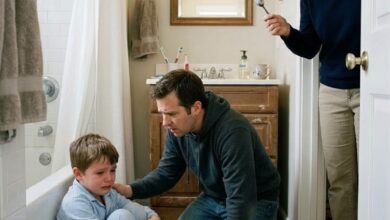
Young woman puts both daughters inside the .. See more

# Both Her Daughters Suddenly Struggled to Breathe — Then a Mother’s Quick Decision Changed Everything
The morning had begun like any other.
A mother had taken her two young daughters outside for fresh air, hoping to enjoy a peaceful walk before the responsibilities of the day took over.
The girls were laughing, stopping to examine flowers and pointing excitedly at birds in the trees.
Nothing about the moment suggested that, within minutes, their mother would be facing one of the most frightening experiences of her life.
Then her youngest daughter began coughing.
At first, it seemed ordinary.
Children cough for countless reasons, and the mother thought perhaps her daughter had swallowed something the wrong way.
But the coughing continued.
Then her older daughter stopped walking.
She looked unusually pale and complained that she felt dizzy.
Within seconds, the mother noticed something that made her heart race.
Both girls were struggling.
Their breathing sounded different.
Their expressions had changed.
And the playful energy that had filled the morning was suddenly gone.
She didn’t know what was happening.
But she knew she couldn’t ignore it.
What followed would become a frightening lesson about the importance of recognizing a possible medical emergency and seeking help without delay.
*Editor’s note: This is a fictional story created to illustrate emergency awareness. The characters and events are not presented as a documented incident.*
## An Ordinary Walk Takes a Frightening Turn
The family had been enjoying a neighborhood park.
It was the kind of place where parents brought children to play, neighbors walked their dogs, and older residents sat beneath the shade of familiar trees.
The mother had visited many times before.
She knew the pathways and the benches.
She knew where the children liked to stop and explore.
Her daughters had been particularly interested in a patch of plants near the walking trail.
They had crouched beside the bushes, studying the leaves and watching insects moving nearby.
Their mother remained close.
Nothing seemed unusual.
But a few minutes later, the younger girl began rubbing her eyes.
The older child said her throat felt uncomfortable.
Then came the coughing.
Their mother initially encouraged them to step away from the plants.
She thought moving into the open air might help.
Instead, the symptoms seemed to become more concerning.
The youngest daughter reached for her mother’s hand.
The older girl struggled to explain how she was feeling.
That was when the mother understood that the situation might require immediate medical attention.
## The Moment Fear Took Over
Parents often describe emergencies as moments when time seems to behave strangely.
A few seconds can feel impossibly long.
Ordinary sounds disappear beneath the urgency of what is happening.
The mother could hear her daughters breathing.
She could see their discomfort.
But she couldn’t understand the cause.
Had something in the park triggered an allergic reaction?
Had the girls come into contact with an irritating substance?
Was there another medical explanation?
She didn’t know.
And trying to make a diagnosis while both children were showing troubling symptoms would only delay help.
She took out her phone and called 911.
Her voice trembled as she explained that both daughters were experiencing breathing difficulties.
The dispatcher asked questions about their condition and location.
She answered as clearly as she could.
An ambulance was being sent.
Now she needed to keep the girls as calm and comfortable as possible while following the dispatcher’s instructions.
## Waiting for Help
The hardest part was not knowing what would happen next.
The mother stayed beside her children, speaking softly while watching for changes.
A woman walking nearby noticed something was wrong.
She approached and asked whether assistance had been requested.
The mother nodded.
Another bystander helped identify the nearest entrance to the park so the emergency team could find them quickly.
Nobody tried to turn the situation into a spectacle.
They simply helped where they could.
One person remained near the trail entrance to guide responders.
Another gave the family space.
The mother continued listening to the dispatcher.
She wanted to do everything correctly.
But her hands were shaking, and concentrating on each instruction took effort.
She had never imagined that a familiar morning walk could become an emergency involving both of her children.
## The Sound of Sirens
When the ambulance finally arrived, relief came mixed with fear.
The mother was grateful to see trained professionals.
But she was also terrified of what their arrival might mean.
The paramedics approached the family and immediately began assessing the girls.
They asked about the onset of the symptoms, possible exposures, and any known medical conditions.
Their questions were calm and focused.
The mother explained everything she remembered.
The children had been playing near plants.
The coughing had begun unexpectedly.
Both girls had become uncomfortable within a short period.
She wasn’t certain whether they had touched anything unusual.
The paramedics assessed their breathing and other vital signs and provided care appropriate to their condition.
Soon, the children were being transported for further evaluation.
The mother went with them.
For the first time since the symptoms began, she felt that the situation was no longer hers to manage alone.
## The Hospital Questions She Could Not Answer
At the hospital, medical professionals continued examining the girls.
The mother repeated the details of the morning.
She described the park, the bushes, and the sudden change in their behavior.
She wanted the doctors to identify the cause immediately.
But the team explained that several conditions could produce overlapping symptoms.
Coughing and dizziness alone did not establish what had happened.
Environmental exposure was one possibility.
Other medical explanations also needed consideration.
The doctors focused first on assessing the children’s condition and determining whether they needed continued treatment.
For their mother, every question felt important.
Had they encountered something dangerous?
Would the symptoms return?
Could she have recognized the problem sooner?
The medical team reassured her that seeking emergency assistance had been appropriate given the breathing concerns.
There would be time to review possible causes.
The immediate priority was the girls’ wellbeing.
## The Longest Afternoon of Her Life
Hours passed slowly.
The mother remained close as the children were monitored.
She watched their expressions and listened whenever they spoke.
Gradually, their discomfort lessened.
The younger girl became more interested in her surroundings.
Her older sister asked when they could go home.
Those ordinary questions brought the mother enormous relief.
Not because every uncertainty had been resolved.
But because the children were improving.
The medical team continued assessing them and explained what symptoms would require urgent attention in the future.
The cause of the episode had not been established with certainty.
A follow-up appointment was recommended to discuss the possible triggers and any additional evaluation that might be appropriate.
Eventually, the doctors determined that both children were stable enough to leave.
Their mother listened carefully to the discharge instructions.
She wanted to understand what to watch for, whom to contact, and how to respond if another episode occurred.
## The Drive Home
By the time the family returned home, the day felt entirely different.
The familiar rooms looked the same.
Their toys were still scattered around the living room.
A small pair of shoes sat beside the door.
But their mother found herself noticing things she normally overlooked.
She watched the girls drink water.
She listened to their voices.
She smiled when they began arguing over a favorite blanket.
Ordinarily, she might have told them to stop.
That evening, the sound was strangely comforting.
It reminded her that they were home.
Safe for the moment.
And returning to their familiar routines.
The experience had frightened all three of them.
But the mother was determined not to let one emergency turn every future outing into a source of fear.
She wanted her daughters to continue exploring the world.
She also wanted to be better prepared.
## What She Learned About Acting Quickly
Before that morning, the mother had assumed she would recognize a serious emergency immediately.
She imagined that danger would always be obvious.
But the episode had begun with symptoms that seemed relatively ordinary.
A cough.
A complaint of dizziness.
A child who suddenly wanted to stop walking.
The concerning part was how quickly those symptoms developed and how they affected both children.
She learned that she did not need to identify the cause before requesting medical help.
She also realized that calmness was not a requirement for taking appropriate action.
She had been frightened.
Her voice had shaken.
She had struggled to remember the simplest details.
But she had still contacted emergency services and followed professional instructions.
That mattered more than appearing fearless.
## When Breathing Problems Require Urgent Attention
The fictional family’s experience highlights a genuine safety issue.
Sudden breathing difficulty in a child can be a medical emergency.
Potential warning signs include severe or worsening difficulty breathing, unusual sleepiness or confusion, fainting, or symptoms suggesting a serious allergic reaction.
Anaphylaxis is one possible cause of rapidly developing symptoms.
It may involve breathing difficulties, swelling, dizziness, or other symptoms affecting different body systems.
However, not every episode of coughing or dizziness is an allergic reaction.
A medical assessment is necessary to determine the cause.
For suspected life-threatening symptoms in the United States, calling 911 is appropriate.
If a child has a prescribed epinephrine auto-injector for anaphylaxis, caregivers should follow the child’s emergency action plan.
Epinephrine is the first-line treatment for anaphylaxis.
Antihistamines are not a replacement for epinephrine during a severe allergic reaction.
Prompt emergency medical care remains important even if symptoms improve.
## The Strangers Who Helped
Later, the mother found herself thinking about the people who had helped at the park.
They had not performed dramatic rescues.
They had not attempted medical procedures they weren’t trained to provide.
Instead, they had recognized a family in distress and offered practical assistance.
One helped direct the ambulance.
Another made space for the emergency responders.
Their actions had allowed the mother to focus on her children.
It reminded her that people do not need special equipment to be useful during every emergency.
Sometimes, helping means calling emergency services, providing accurate location information, or following a dispatcher’s instructions.
Sometimes, it means stepping aside so trained professionals can work.
Knowing the limits of one’s abilities is part of responding responsibly.
The mother was grateful that the bystanders had offered support without creating additional confusion.
## Why Parents Sometimes Second-Guess Themselves
In the days that followed, the mother replayed the morning repeatedly.
She wondered whether she should have noticed the symptoms earlier.
She questioned whether she had allowed the girls too close to the plants.
She worried about taking them outside again.
Those thoughts were difficult to dismiss.
But she also recognized that she had not possessed the information available to the hospital team.
She could not have known what would happen before the symptoms appeared.
And she could not be expected to identify every possible medical condition.
Her responsibility had been to respond to the warning signs she could observe.
That was what she had done.
The experience did not make her an expert in emergency medicine.
It made her more aware of how quickly ordinary circumstances can change.
## Returning to the Park
Several weeks later, after discussing the episode with the children’s healthcare team, the mother decided to take another walk.
She chose a familiar route.
The girls were excited to be outside again.
For a moment, she hesitated near the park entrance.
She remembered the ambulance.
The uncomfortable questions.
The hours spent waiting in the hospital.
But she also remembered how much her daughters enjoyed being outdoors.
She didn’t want their lives to become defined by the frightening experience.
They walked slowly along the pathway.
The youngest pointed toward a bird.
Her older sister asked whether they could visit the playground.
Their mother smiled.
This time, the ordinary sounds of the park felt especially welcome.
She had learned how to prepare, how to ask for help, and how to respond to uncertainty.
And she was learning something else.
Being careful did not have to mean living in fear.
## What the Morning Really Changed
The mother never forgot that day.
Not because she had made a dramatic speech.
Not because she had somehow known exactly what was wrong.
And not because every question about the episode had received a simple answer.
She remembered it because ordinary life had changed without warning.
Her daughters had needed help.
She had recognized that something was seriously wrong.
And she had contacted professionals who were equipped to respond.
The experience reminded her that love is not always expressed through grand gestures.
Sometimes it appears in a parent’s willingness to acknowledge uncertainty.
Sometimes it is a phone call made with shaking hands.
Sometimes it means putting aside the need to understand everything and asking for help.
**She couldn’t explain what had happened to her daughters that morning. But she understood one thing clearly: when their breathing changed and she feared for their safety, waiting to be certain was not worth the risk.**
That decision did not make her fearless.
It made her a mother who acted when her children needed her.
And when the girls finally returned to their ordinary laughter, that was enough.
*This story is fictional and intended for general awareness. It is not a substitute for professional medical advice or emergency guidance.*