This morning, I went out into the yard—just to water the flowers and check if the cats had scattered litter, as usual.
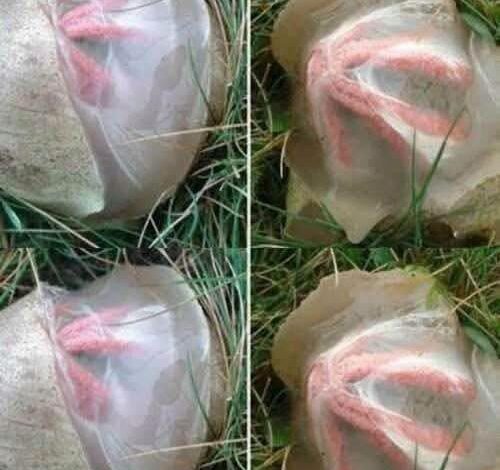
This morning I Found a Strange Red Growth in My Garden and Thought It Was Poison — Then I Looked Closer
I thought it was poison.
That was my first reaction when I spotted something bright red sitting beside the garden bed.
It was a quiet morning, the kind when nothing particularly unusual is supposed to happen. I had stepped outside expecting to enjoy a few peaceful minutes among the plants before starting my day.
Instead, something near the soil stopped me in my tracks.
It was a strange, glossy red lump, unlike anything I remembered seeing in my garden.
Its surface appeared folded and irregular, almost as if something had been carefully shaped and then abandoned beside the plants.
For a moment, I couldn’t tell whether it was a fungus, a discarded object, or something far more concerning.
And because I didn’t recognize it, my mind immediately imagined the worst.
Was it poisonous?
Could it spread?
Was it dangerous to the plants growing nearby?
I stood there staring at it, wondering whether I should leave it alone, remove it, or find someone who could explain what I was looking at.
What happened next reminded me how easily fear can fill the space where knowledge is missing.
## The Strange Discovery Beside My Garden
My garden had always been a place where I felt comfortable.
I knew where the soil stayed damp, which plants needed extra attention, and which corners tended to collect fallen leaves.
Occasionally, I found insects or ordinary mushrooms after wet weather.
Nothing about those discoveries had ever seemed particularly remarkable.
But this was different.
The color caught my attention first.
It was a deep, striking red, standing out sharply against the darker soil.
Then I noticed the texture.
The surface looked almost wet, with folds that caught the morning light.
It didn’t resemble the familiar cap-and-stem mushrooms I had seen before.
That unfamiliar shape made it even more unsettling.
I leaned forward for a better look but stopped before getting too close.
There was something almost artificial about its appearance, as though someone had placed a strange object in the garden overnight.
Yet it seemed to belong to the ground around it.
I could see no obvious explanation.
And without realizing it, I had already decided that something so unusual must represent a problem.
## Why My Mind Immediately Imagined Danger
Looking back, the most surprising part of the experience wasn’t the red object itself.
It was the speed of my reaction.
I had no evidence that it was harmful.
I hadn’t identified it.
I hadn’t watched it damage a plant or threaten anything nearby.
Still, my first thought was that it might be dangerous.
Perhaps it was the color.
Bright red can signal warning or danger in many familiar contexts.
Perhaps it was the glossy surface, which looked so different from the ordinary textures of soil and leaves.
Or perhaps it was simply the fact that something unfamiliar had appeared in a place I considered my own.
Whatever the reason, fear arrived before understanding.
For a moment, I considered walking away and ignoring it.
Then I imagined returning later and discovering that it had spread across the garden.
Of course, I didn’t know whether it could spread at all.
That possibility existed only in my imagination.
And the more I stared at the object, the more I recognized that I was reacting to what I feared it might be rather than what I actually knew.
So I decided to learn more.
## A Closer Look Changed My First Impression
Instead of immediately trying to destroy or remove the strange growth, I took a little more time to observe it.
I stayed far enough away to avoid disturbing it.
I studied its shape, the way it emerged near the soil, and the folds across its surface.
Nothing was moving.
Nothing was attacking the nearby plants.
It was simply there.
That might sound obvious, but the realization helped me settle down.
A moment earlier, I had been treating the object almost as though it had intentions.
Now I was beginning to recognize that it might simply be another living organism appearing under conditions I hadn’t noticed.
I took a photograph.
Then I began searching for examples of unusual red fungi found in gardens.
What appeared on the screen surprised me.
There were photographs of mushrooms and other fungal growths in extraordinary colors and shapes.
Some resembled delicate cups.
Others had branching structures, gelatinous surfaces, or strange arrangements of folds.
Many looked nothing like the ordinary mushrooms sold in grocery stores.
I had always known that fungi came in different forms.
But I hadn’t appreciated just how unfamiliar some of them could appear.
Suddenly, the object beside my garden bed seemed less like an unexplained threat.
It seemed like something that might have a perfectly natural explanation.
## The Unusual World of Fungi
Fungi are far more diverse than the familiar mushrooms most people recognize.
They can appear in forests, lawns, gardens, mulch, rotting wood, and other environments where suitable conditions exist.
Some grow in recognizable forms with caps and stems.
Others form shelves on trees, branching structures, cup-like shapes, or gelatinous masses.
Their colors can also vary dramatically.
Depending on the species, fungi may appear white, brown, yellow, orange, purple, or red.
In some cases, the visible structure is only a temporary reproductive part of a much larger organism.
Much of the fungus may exist out of sight as a network of fine threads called mycelium.
These threads can grow through soil, decaying wood, or other suitable material.
The structures we notice above ground may appear when environmental conditions encourage reproduction.
That helps explain why a garden can seem completely ordinary one day and contain an unexpected fungal growth the next.
Moisture, temperature, and available organic material can influence when fungi become visible.
A sudden appearance is not necessarily evidence of something dangerous or invasive.
Sometimes it is simply an organism becoming noticeable after spending much of its life hidden from view.
## Could the Red Growth Have Been Harmless?
As I continued researching, I found descriptions of fungi whose unusual appearances seemed much more dramatic than their actual effects on the surrounding environment.
Some fungi play an important role in breaking down dead organic material.
Others interact with living plants.
Their presence can be part of the natural processes occurring in soil and garden ecosystems.
That information challenged my original assumption.
A bright color or unfamiliar shape did not automatically mean danger.
But I also discovered something important.
A photograph and a quick internet search are not enough to prove that an unknown fungus is harmless.
Different species can share similar colors, textures, and general shapes.
Even experienced identifiers sometimes need several views, information about the growing environment, or closer examination to distinguish them.
That meant I couldn’t responsibly give my garden discovery a definite name based only on its appearance.
I also couldn’t assume it was safe to eat or handle carelessly.
The more I learned, the clearer the distinction became.
My original panic had not been justified by evidence.
But reassurance needed evidence too.
Understanding that difference felt more valuable than finding an immediate, comforting answer.
## What Gardeners Should Know About Unfamiliar Mushrooms
Finding mushrooms or other fungal growths in a garden is not automatically a sign that something has gone wrong.
According to university extension specialists, many fungi that appear in landscaped areas are associated with the breakdown of organic material.
They may be growing on buried roots, decaying wood, mulch, or other material in the soil.
In some situations, these organisms contribute to nutrient recycling.
However, not every fungus has the same relationship with surrounding plants.
Some are associated with plant diseases, while others are not harmful to the garden.
That is why identification and context matter.
A fungus growing on dead mulch is not necessarily behaving like one affecting a living tree.
The important details include where it is growing, what material it is attached to, and whether nearby plants show signs of a problem.
Homeowners should also remember that an unusual appearance does not establish whether a mushroom is poisonous.
Experts advise against eating any unidentified wild mushroom.
This is especially important in gardens accessible to small children or pets, who might accidentally put unfamiliar objects in their mouths.
If there is concern about a growth, taking clear photographs and contacting a local university extension office or knowledgeable mycological group may be more useful than relying on a single online image.
## The Lesson Hidden in an Ordinary Morning
By the time I finished reading, the morning felt different.
The garden hadn’t changed.
The plants were still where they had been.
The red growth remained beside the soil.
But I no longer viewed it through the same immediate fear.
I had begun the morning imagining something toxic and threatening.
Now I understood that I was looking at a natural mystery, one that deserved observation rather than panic.
There was even a little embarrassment in realizing how quickly my imagination had taken control.
I had constructed an entire story about danger without knowing the identity of the object in front of me.
I had treated its unusual appearance as evidence that something was wrong.
Yet the first useful thing I had done was neither run away nor destroy it.
I had stopped and asked questions.
That simple choice changed my experience.
Instead of allowing fear to determine my reaction, I had given curiosity a chance.
And curiosity led me toward information.
Not every answer was complete.
I still didn’t have a scientifically confirmed identification.
But I had learned enough to recognize the limits of my original assumptions.
Sometimes, understanding begins with admitting how much we don’t know.
## Why the Unknown Can Feel So Frightening
Later that day, I found myself thinking about the experience again.
It seemed strange that something so small had occupied so much of my attention.
But perhaps the reaction was understandable.
People often feel uneasy when familiar surroundings change unexpectedly.
An unusual sound in the house, a strange shape in the yard, or an unfamiliar creature near the doorstep can make ordinary places feel uncertain.
The mind wants an explanation.
And when reliable information isn’t immediately available, it may rush toward the most alarming possibility.
Sometimes that caution is useful.
Real dangers do exist, and unfamiliar things occasionally require careful attention.
But there is a difference between responding responsibly to uncertainty and allowing fear to invent conclusions.
That distinction stayed with me.
The red growth had never needed to become a monster in my imagination.
I could have approached the situation carefully from the beginning.
I could have observed it, documented it, and searched for trustworthy information without assuming the worst.
Instead, I first allowed its appearance to decide how I felt about it.
It was a small lesson.
But an unexpectedly memorable one.
## Beauty Doesn’t Always Look Familiar
One of the things I appreciated most after researching unusual fungi was realizing how limited my idea of natural beauty had been.
When I imagined a healthy garden, I pictured flowers, green leaves, and neatly arranged beds.
I hadn’t thought much about the organisms living in the soil or helping break down the materials that eventually support new growth.
And I certainly hadn’t imagined that a glossy red fungus could become the most memorable thing I saw all morning.
Yet there it was.
Something I had initially viewed with alarm now seemed strangely fascinating.
Its irregular folds and unusual color were not evidence of wrongdoing.
They were simply features I didn’t recognize.
That realization made me look around the garden differently.
I began noticing details I usually overlooked.
The textures of fallen leaves.
The small changes in the soil after rain.
The quiet activity taking place in spaces I rarely inspected.
The garden hadn’t become more mysterious overnight.
I had simply started paying closer attention.
## What I Would Do Differently Next Time
If I discovered another unusual growth in the garden, I wouldn’t automatically assume it was harmless.
But I wouldn’t immediately decide that it was dangerous either.
I would begin by observing it without disturbing it.
I would photograph the growth from several angles and note whether it appeared in soil, mulch, or decaying wood.
I would check whether nearby plants looked healthy.
If there were children or pets with access to the area, I would take appropriate precautions to prevent accidental ingestion.
And if I needed a definite identification, I would seek reliable expert guidance rather than trusting the first visual match online.
These are not dramatic steps.
They are simply practical ways to replace uncertainty with better information.
The discovery reminded me that staying calm doesn’t mean ignoring potential risks.
It means recognizing risks without pretending to know more than I actually do.
## What That Red Fungus Taught Me
By the end of the day, I had stopped thinking of the discovery as a frightening interruption.
Instead, I remembered it as an unexpectedly useful lesson.
That morning, I had seen something unfamiliar and immediately imagined danger.
I had allowed the shape and color of an object to create a story before I understood the facts.
Then I stayed.
I looked more carefully.
I learned about the extraordinary variety of fungi and the important roles many of them play in nature.
Most importantly, I learned that curiosity and caution can exist together.
I didn’t need to treat every unfamiliar thing as harmless.
But I also didn’t need to treat it as a threat.
The strange red growth remained a mystery until it could be properly identified.
And that was all right.
Not every question needs an immediate answer.
Sometimes the important change happens in the way we approach what we don’t understand.
**I walked into my garden that morning thinking I had discovered something poisonous. What I really discovered was how quickly fear can take the place of knowledge — and how much can change when we choose to look closer.**
*Editor’s note: This is an expanded first-person narrative based on the supplied story. The fungus is not identified to species, and no claim is made that an unidentified wild fungus is safe to eat or handle without precautions.*